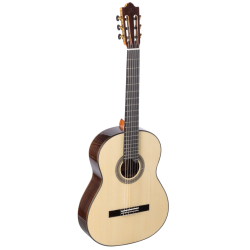
WHY CHOOSE AN ADMIRA FLAMENCO GUITAR
Flamenco guitars are built for a rapid response: sharp attack, percussive snap, and precise rhythm (compás). When performing rasgueos, alzapúa, or golpes, a flamenco guitar delivers that punchy kick required by the style. In the shop, we summarize it like this: if your music relies on rhythm, accents, and immediate response, a flamenco guitar makes it easy.
Admira provides very straightforward choices and an excellent guide to finding the right fit:
- Easy-to-understand catalogue: beginner models, standard 4/4 models, and electro-acoustic options.
- Comfortable learning: a flamenco guitar is an excellent companion for developing right-hand technique and a strong sense of rhythm.
- Live performance options: if you need to plug in to avoid relying on external microphones, the brand offers models designed specifically for this.
- Hassle-free shopping: choose based on your goal (starting out / studying / plugging in) and quickly narrow down your options.
ADMIRA FLAMENCO GUITARS BY SERIES (WITH STANDOUT MODELS)
Beginner: Starting with a flamenco guitar without the fuss
If you're just starting out, the most valuable asset is a guitar that doesn't hold you back: a comfortable posture, a fingerboard that lets your right hand work the rhythm, and a feel that motivates you to practice. In this category, the direct recommendations to get started are:
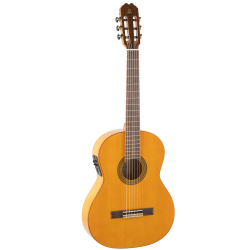
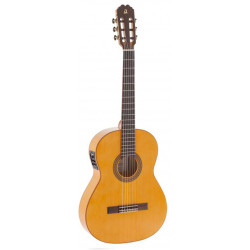
- Admira Triana: a clear choice if this wood combination suits you and you want an entry-level flamenco guitar in a standard format.
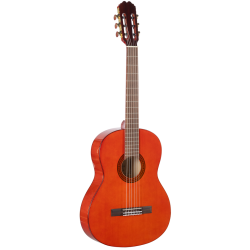
- Admira Macarena: a slightly more professional option if you prefer a solid top from day one for richer sound quality.
Standard 4/4 Flamenco: For serious study and playing more advanced repertoire
Once you have a set routine (lessons, methods, palos, falsetas), you'll want a standard flamenco guitar that responds accurately to your attack and dynamic expression. Here are the models available to choose from based on feel and preference:
- Admira Carmen Flamenco: features a solid cedar top with rosewood back and sides, an ebony fingerboard, and 20 frets. It also includes a truss rod for precise adjustments and a pre-installed tap plate (golpeador).
- Admira Flamenco F4: features a solid spruce top with cypress back and sides, an ebony fingerboard, and 19 frets. The neck is made of mahogany reinforced with rosewood. This is a higher-end option within the Admira range.
Electro-Acoustic with Cutaway: For players who need stage readiness and easy upper-fret access
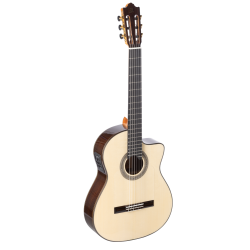
If your plans include playing plugged in (rehearsals with a PA, live gigs, or direct line recording), an electro-acoustic flamenco guitar simplifies everything: just plug in and control your volume without worrying about external mics. In this category, the go-to option is:
FAQ
What is the difference between a classical guitar and a flamenco guitar?
A flamenco guitar is designed for quick response, sharp attack, and percussive qualities suited for rhythm (compás). A classical guitar focuses on warmth, roundness, and sustain for classical repertoire.
Which model should I choose to start playing flamenco?
In this category, the ideal beginner choice is the Admira Macarena.
What do I gain with a standard 4/4 flamenco guitar compared to a beginner model?
You get more long-term potential and a higher-quality instrument that allows for longer practice sessions and greater tonal nuance. In this category, the standard 4/4 options are the Admira Triana, Admira Carmen, and Admira Flamenco F4.
When is an electro-acoustic flamenco guitar recommended?
When you plan to play amplified (rehearsals, live shows, or direct line recording). In this category, that specific option is the Admira Triana Cutaway Fishman.
What is the purpose of a cutaway on a flamenco guitar?
It allows you to reach the higher notes on the neck much more comfortably. If you frequently play melodies or falsetas up high, it makes a huge difference.