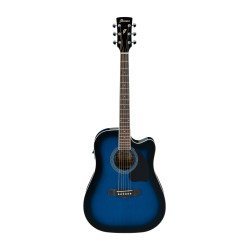
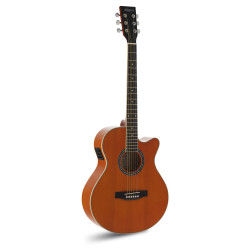
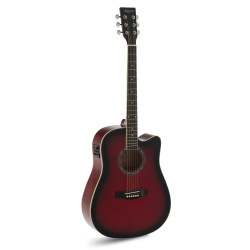
HOW TO CHOOSE YOUR FIRST ACOUSTIC GUITAR?
To choose a beginner acoustic guitar, prioritize comfort, playability, and a body size that suits you. A guitar that you can hold easily and whose strings don't require excessive effort will make practicing chords, position changes, and strumming much easier during the early stages.
It's also worth considering how you plan to use it. You don't need the same type of guitar to accompany vocals with chords as you do to play intricate fingerstyle arrangements, travel with it frequently, or plug it into a PA system.
CHOOSE THE BODY SIZE BASED ON COMFORT AND SOUND
The size and shape of the body influence both the playing feel and the acoustic response. There is no single shape that is best for all beginners.
| If you are looking for... |
Shape to consider |
Why? |
| Volume, body, and accompaniment |
Dreadnought |
Its larger body offers a full-bodied response and good projection, making it especially suitable for strumming and accompaniment |
| Balance and comfort |
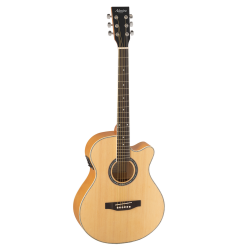
Concert / Auditorium |
Its body is usually more manageable and can be a comfortable option for practicing seated for long periods |
| A more compact guitar |
Parlor / Mini |
Its reduced dimensions can make posture easier for shorter guitarists or those who prefer smaller instruments |
These guidelines are just a reference. Two guitars with the same shape can feel different due to their body depth, neck, scale, and construction, so comfort should always remain one of your main criteria.
COMFORT, NECK, AND STRING ACTION
Acoustic guitars typically use steel strings and may initially require a bit more finger pressure from your fretting hand than an electric guitar. That's why it is especially important that the instrument is properly set up.
The action is the distance between the strings and the frets. If it is excessively high, you will have to press harder to fret notes and form chords. For a beginner, a comfortable, well-set-up guitar can be much more important than choosing based solely on price or on-paper specs.
ACOUSTIC OR CLASSICAL GUITAR TO START?
It is not mandatory to learn on a classical guitar before playing an acoustic one. The choice mainly depends on the music you want to play and the playing feel you prefer.
Acoustic guitar
It usually features steel strings and is a common choice for pop, folk, indie, country, acoustic rock, and vocal accompaniment. Its sound has a brighter, more defined attack.
Classical guitar
It features nylon strings and a generally wider neck. It might be a better fit if you want to study classical repertoire, certain traditional styles, or if you simply prefer the feel of nylon strings.
Which one to choose?
Start with the instrument that matches the music you truly want to learn. Motivation to practice and comfort are more important than following the idea that every beginner must necessarily start with a classical guitar.
If you are still unsure between the two options, check out our guide on classical, acoustic, or electric guitar.
ACOUSTIC OR ELECTRO-ACOUSTIC FOR BEGINNERS?
An electro-acoustic guitar still works as a regular acoustic guitar when unplugged. The difference is that it features a built-in system that allows you to send its signal to an amplifier, mixing console, interface, or other compatible gear.
Acoustic guitar
It's enough if you are mainly going to play at home, study chords, practice accompaniments, or play without amplification. You don't need electronics to learn.
It might interest you if you want to plug in during rehearsals, gigs, lessons, recordings, or any situation where you need to directly amplify the guitar's signal.
If you don't plan on plugging it in, the preamp shouldn't be your main buying criteria. If you know you will use amplification, check out our specific selection of beginner electro-acoustic guitars.
WHAT ACOUSTIC GUITAR BRANDS CAN YOU CHOOSE TO START WITH?
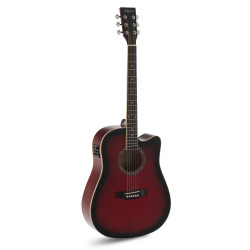
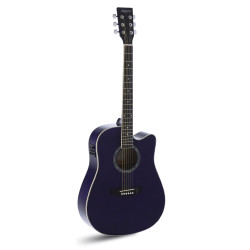
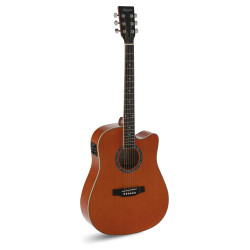
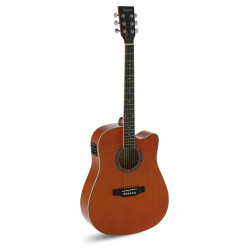
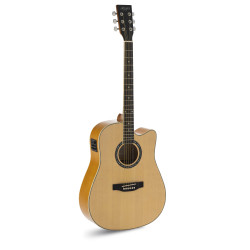
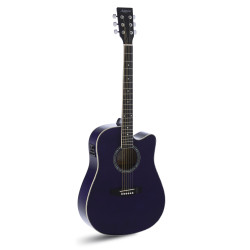
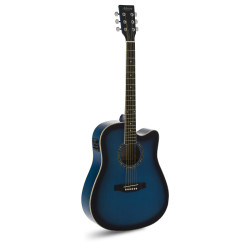
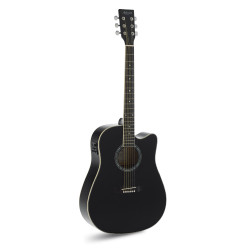
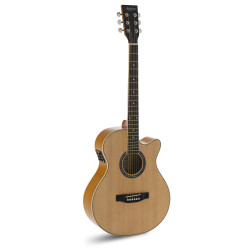
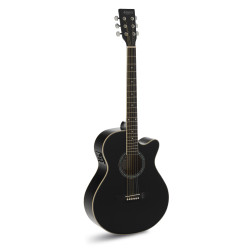
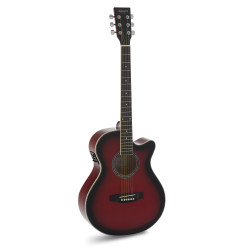
Admira and Cort are two of the most prominent brands currently in our selection of beginner acoustic guitars. Within their ranges, you will find different body shapes, finishes, and options with or without electronics.
Admira has a wide selection of acoustic guitars aimed at beginners, including different versions from families like Tennessee and Indiana. It is a brand worth considering if you are looking for various body, finish, and hardware options on a budget.
Cort offers beginner models with different body shapes. Their range allows you to compare, for example, Dreadnought and Concert designs depending on whether you prefer a larger body or more manageable dimensions.
WHAT DETAILS TO LOOK AT BEFORE BUYING YOUR FIRST ACOUSTIC GUITAR?
Solid or laminated top
A solid top can offer a richer response and more nuances, but it's not essential for learning. A properly built and well-set-up laminated guitar can be perfectly valid as a first instrument.
With or without a cutaway
The cutaway is the scoop in the body that allows easier access to the higher frets. If you are mainly going to start by playing chords, strumming, and accompaniments, it is not an essential feature.
With or without a preamp
The preamp becomes important if you want to plug the guitar into an amplification system. To practice acoustically at home, you can easily start with a guitar without electronics.
WHAT ELSE DO YOU NEED BESIDES AN ACOUSTIC GUITAR?
You don't need much gear to get started. A tuner will help you keep the guitar properly tuned at all times, and a few picks of different thicknesses will let you find which one feels most comfortable for strumming or playing individual notes.
It can also be useful to have a gig bag to store and transport the guitar, a strap if you want to play standing up, a spare set of strings, and a capo for when you start playing songs that require one. You don't need to buy all these accessories on day one.
FREQUENTLY ASKED QUESTIONS ABOUT BEGINNER ACOUSTIC GUITARS
What is a good beginner acoustic guitar?
A good beginner acoustic guitar should be comfortable, hold its tuning well, and allow you to fret the strings without excessive effort. Body size is also important: a Dreadnought might interest you for its body and projection, while Concert or Auditorium shapes can be more manageable.
Is an acoustic or classical guitar better for a beginner?
Neither is strictly better for all beginners. The acoustic normally uses steel strings and fits especially well with pop, folk, country, and acoustic rock. The classical uses nylon strings and might appeal to you more for classical repertoire or if you prefer that type of feel and sound. It's recommended to start with the instrument that matches the music you want to learn.
Dreadnought or Concert to start?
A Dreadnought offers a large body with good projection and can be especially suited for strumming and accompaniment. A Concert has a more compact body and can be more comfortable for shorter guitarists or anyone who prefers a more manageable instrument. Both can be suitable for learning.
Do I need an electro-acoustic guitar to learn?
No. You can easily use an acoustic guitar without electronics to learn and practice at home. An electro-acoustic is especially worthwhile if you want to connect it to an amp, mixing console, interface, or other amplification system.
Is it normal for acoustic guitar strings to feel hard to press at first?
The steel strings of an acoustic guitar may initially require more pressure than those of an electric guitar, and your fingers need an adaptation period. However, an excessively high action can make playing unnecessarily difficult, which is why it's important that the guitar is properly set up.