
How to Arrange Pedals in Your Signal Chain?

Once you start building up a collection of pedals, the questions start building up too. One of the most common is this: how should you arrange your pedals to get the sound you actually want? That is exactly what we are going to look at today, so you can build a more “standard” pedalboard setup and understand why certain effects are usually placed in certain positions.
As we always say, there is no exact science here and no fixed, unquestionable order for how pedals must be arranged in an effects chain. In fact, we would strongly encourage you to break these rules and experiment until you find the sound you have in your head.
Still, it helps to understand the usual logic behind a pedal chain. So let’s go through each type of effect and where it is typically placed in order to get a balanced sound and keep your guitar signal as clear as possible.
In the image below, you can see how a standard pedalboard signal chain would usually be arranged:
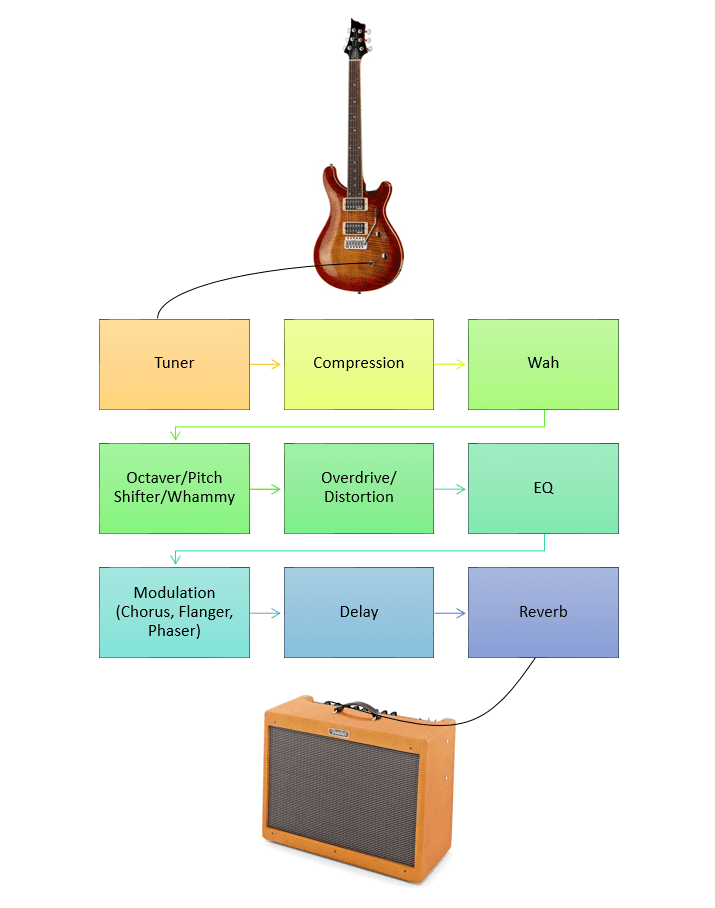
TUNER
The first pedal in contact with your guitar signal should be the tuner. This is one of the few placements that is generally considered non-negotiable. The reason is simple: you want the tuner to receive the cleanest signal possible so it can track your pitch more accurately.
It is also worth pointing out that most tuning pedals mute your signal when engaged, which is useful because it lets you tune silently without disturbing the rest of the band or the audience. A great example of this is the Boss TU-3.
COMPRESSOR
The compressor would usually come next. It works best when it receives as clean a signal as possible, and placing it early in the chain helps preserve the natural dynamics of your playing while allowing the pedal to do its job properly.
If you were to place it at the very end of the chain, it would be reacting to all the effects before it, which could flatten your sound too much and reduce a lot of the natural dynamics in your tone.
WAH AND SIMILAR EFFECTS
Right after dynamics pedals such as compressors, you would usually place effects like wah, octave pedals, pitch shifters, Whammy-style pedals and similar processors. It is important to place these pedals early enough in the chain so that the transformation they apply to your signal is clear and noticeable within your overall tone.
When it comes to wah pedals specifically, there are also a couple of common alternatives:
- - One option is to place the wah right before your overdrives, distortions or fuzz pedals. In this position, the wah tends to sound more defined, with richer harmonics and a more expressive sweep.
- - Another option is to place it just after those gain pedals. In that case, the effect tends to feel more aggressive, with more saturation, a slight boost-like sensation and less overall definition.
THE CORE OF YOUR TONE: EXPERIMENT AND EXPLORE
This brings us to what is usually the heart of most pedalboards: overdrive, distortion and fuzz.
Here, the best advice is to experiment. These pedals are often the core of your tone, and there is no better way to find the right sound than by trying different combinations for yourself. As a general guideline, it often makes sense to stack gain from lower to higher. In other words, overdrive first, then distortion after it.
Fuzz is a different story. Depending on the type of fuzz you are using, it may work best right at the beginning of the chain, or it may actually perform better as the final gain stage.
So when it comes to gain pedals, do not be afraid to test different positions. That is often where the most unique and personal tones come from!
HOW TO ENHANCE YOUR TONE
Once you move past the core of your gain section, the next logical step is to use something that enhances the tone you have worked so hard to build. That is where an EQ pedal or a booster can come in.
With an EQ pedal, you can boost or cut the frequencies you want in order to shape your tone more precisely. Some pedals offer a simpler control layout, where you can emphasise brighter or darker frequencies more generally, while others let you target specific frequency bands in much more detail.
A booster, on the other hand, is usually used to give you a clean volume lift. This is especially useful for lead playing and solos.
It is also worth mentioning that some pedals combine both functions, so you may find pedals that work as both an EQ and a boost in one unit.
MODULATION PEDALS
After that part of the chain, modulation effects usually come next. This includes pedals such as chorus, flanger, tremolo and phaser.
This is an important place for them because they are now adding movement, texture and colour to the tone you have already shaped earlier in the chain. This is often where a pedalboard starts to develop more of its own personality.
TIME-BASED EFFECTS
Finally, we reach the time-based effects. These are the pedals that create the sense of space around your sound, mainly delay and reverb. They are usually placed at the end of the chain so that the repeats and ambience sound as clear and natural as possible.
As for the order between the two, delay would normally come first so your guitar sits within the space you are creating, and reverb would come last to wrap the whole sound in ambience.
This pedal order is based on running your entire signal chain straight into the input of your amplifier. However, you have probably noticed that many amplifiers also feature an FX loop, usually labelled send and return. If you want to use that option, then you need to split your pedals between those going into the amp input and those going through the FX loop.
The most common approach is to place modulation and time-based effects in the FX loop so that they sound cleaner and stay more faithful to the original effect signal. The rest of the pedals, especially gain and tone-shaping effects, would normally go into the amp input so they interact directly with the front end of the amplifier and help define your core sound along with the amp’s own character.
KEEP TRYING UNTIL YOU FIND YOUR SOUND
As with everything in music, it all comes down to trying things out until you find what truly feels right for you. At Mat Guitars & Bass, we always recommend experimenting as much as possible until you land on the tone you have in your head.
If you have any questions or need advice on effects and pedal setups, our team will be happy to help. Feel free to visit our store, we will be delighted to help you find the right setup.
Phone: +34 954 902 550
Whatsapp: +34 647 639 532
E-mail: info@matguitars.com
And of course at our store in Mairena del Aljarafe, Seville
Until next time!
Daniel Tamajón Gallardo
Product Specialist.



 English
 Español